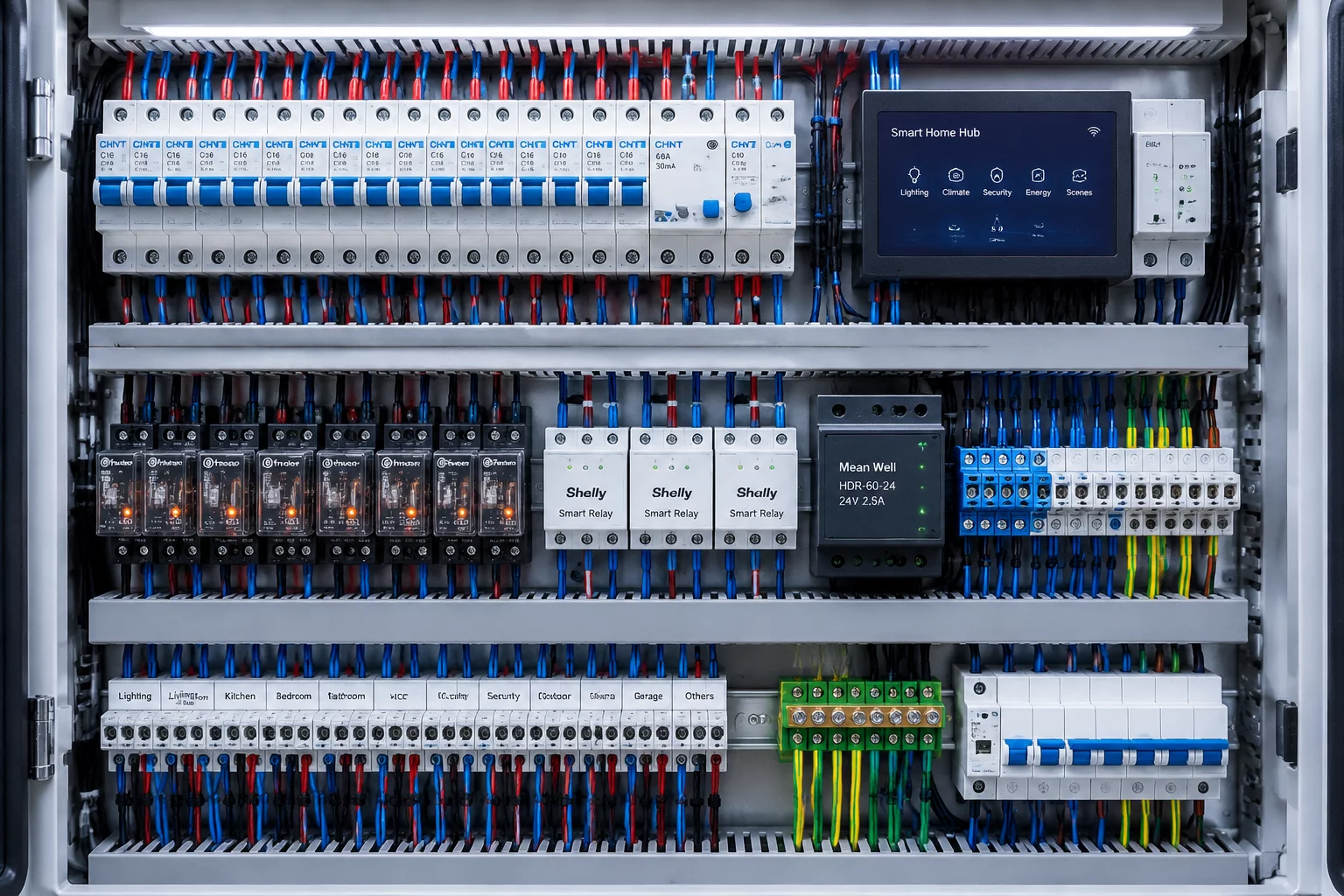
Modern home automation requires far more than wireless gadgets; it demands a dedicated physical electrical backbone capable of delivering stable voltage, continuous neutral pathways, and centralized relay control. This project transformed an ordinary residential electrical grid into an intelligent distribution network designed for scalable home automation. Detailed cable routes, clean DIN-rail modular layouts, and dedicated low-voltage pathways now prevent transient voltage spikes and signal cross-talk across all living areas.
Key Safety Note
Smart home switching components and microprocessor-driven relays require dedicated neutral wiring at every switch point, alongside coordinated Type 2 surge protective devices (SPDs) installed at the main panel to protect delicate circuitry against overvoltage events.
Centralized Distribution Board & Smart Relay Integration
To support high-density automation without overcrowding the enclosure, the team replaced the existing consumer unit with an expanded four-row modular distribution board. This configuration provides dedicated DIN-rail space for DIN-mounted smart relays, energy measurement meters, and isolated signal channels. Each automation group operates through independent miniature circuit breakers, allowing routine maintenance on individual smart zones without disconnecting the entire home network.
- Installation of multi-channel DIN-rail smart relays coupled with individual circuit overcurrent protection.
- Dedicated continuous neutral conductors brought to all wall switch backboxes to power in-wall automation sensors.
- Comprehensive multi-stage surge protection installed directly on the incoming feeder lines to shield microelectronics.
Load Balancing and Interference Elimination
Inductive electrical loads from compressors, heating units, and pump motors can induce electromagnetic interference into sensitive low-voltage automation control lines. The installation team implemented physically separated conduit pathways for high-voltage power feeds and low-voltage bus cables. Solid copper conductors with flame-retardant low-smoke insulation were routed through structured raceways, providing clean power delivery throughout the property.
Verify phase-to-neutral load balancing across automated lighting loops and measure residual current thresholds on each RCD-protected branch to eliminate nuisance tripping during automated simultaneous startup sequences.
The resulting infrastructure gives the homeowners full energy transparency, granular remote power management, and a robust platform ready for future expansions. Every circuit was rigorously tested under full operational load, validating ground continuity, trip response times, and thermal stability across all control modules.
Community Discussions
No comments yet. Be the first to leave a comment.
Leave a Comment
Share your insights, questions, or renovation feedback below.